



Global Outsourcing Trends for 2026
11/10/2025
8 Minute read


2026 outsourcing landscape businesses must know
The outsourcing landscape in 2026 is shaped mainly by two factors: a technology-driven expansion primarily on AI, cloud, and automation and a strategic reorientation of location choices like nearshoring and diverse global delivery. According to a Grand View Research study, the global business process outsourcing (BPO) market is sizable and expanding, with an estimated CAGR of 9.8% from 2025 to 2030. Global businesses will continue to outsource access to specialised skills, speed to market and cost efficiency. AI investments are driving up enterprise IT spending, while regional hubs like the Philippines are expanding service scope and increasing capabilities. These dynamics create both opportunities and responsibilities for firms that understand how to build talent, governance, and risk frameworks around modern outsourcing.
Market size and business dynamicss
The global BPO market is robust and expanding from USD 302.62 billion in 2024 to estimated USD 525.23 billion by 2030. Industry estimates demand for specialised services and digital transformation initiatives are driving the market’s multi-year growth. Simultaneously, AI infrastructure, cloud migration and enterprise software are pushing a steady up-cycle in global IT spending. This investment surge is expected to raise demand for outsourced skills and service partners. To put it briefly, increased corporate tech spending combined with a greater demand for specialised delivery means more opportunities for outsourcing and offshoring teams.
5 trends shaping outsourcing
1. AI + automation reshape what’s outsourced (and how)
Enterprises are moving from AI experimentation to operationalisation. That means outsourcing partners are no longer just seat-fillers for repetitive tasks – they’re expected to deliver AI-augmented outcomes (automated workflows, intelligent document processing, prompt engineering, model monitoring) and to partner on data governance. This raises the bar for provider capabilities with AI literacy, cloud engineering, and security controls are now as important as cost and language skills.
What it means for businesses: Contracts will shift from FTE-based (full-time equivalent) pricing toward outcome- and value-based pricing (pay-per-resolution, per-transformation KPI). Companies should update SOWs to include ownership of datasets, retraining schedules, and explainability/ethics clauses.
2. Talent quality > lowest cost – specialised skills win
Cost arbitrage remains relevant, but access to specialised digital skills (cloud, MLops, cybersecurity, fintech compliance) is the primary driver for many buyers. Outsourcing choices increasingly emphasise workforce upskilling, local talent pipelines, and nearshore options that offer timezone alignment and cultural fit.
What it means for businesses: Expect greater investment in joint training programs, certification guarantees from suppliers, and blended teams that combine onshore architects with offshore delivery squads.
3. Nearshoring and geographic diversification accelerate
Supply-chain and geopolitics have pushed many firms to diversify delivery locations. Nearshoring (especially into Latin America for U.S. firms) and “multi-shore” strategies (a mix of onshore + nearshore + offshore) reduce single-country risk while improving overlap in working hours for collaboration. Nearshore hubs are also investing heavily in STEM education and cybersecurity capabilities to attract higher-value engagements.
What it means for businesses: RFPs increasingly ask for hybrid location mixes and rapid capacity-swaps (ability to move workloads between regions if regulatory or operational risks materialise).
4. Security, privacy and regulatory compliance become non-negotiable
As service delivery becomes more data-intensive, regulatory scrutiny increases (think training data, customer chat logs). Outsourcers must demonstrate encryption, data residency options, identity/access constraints, and incident response capabilities. Higher SLAs for breach notification and stricter audit access will be demanded by buyers.
What that implies for businesses: Security skills will often take precedence above cost and even delivery speed when choosing a provider, especially for sensitive data or regulated industries (healthcare, banking).
5. Outcome-based contracts and shared-risk models become mainstream
Traditional time-and-materials or per-seat models are being complemented (and sometimes replaced) by outcome-based agreements tied to KPIs like NPS, resolution time, revenue per FTE, or automation uplift. This aligns incentives and helps buyers share the risk of transformation investing in new technologies (including AI).
What it means for businesses: Procurement and legal teams must become fluent in service-value metrics and in how to structure gain-share and penalty clauses that are fair and enforceable.
Why outsourcing in the Philippines still matter in 2026
Scale + specialisation
The Philippines remains a top global destination for contact center, customer experience, and knowledge process outsourcing — and it’s growing into higher-value digital services. Industry bodies reported that the Philippine IT-BPM industry generated roughly $38 billion in revenue in 2024 and was on track to exceed $40 billion in 2025, with workforce growth toward the 1.9–2.0 million range. That scale matters: mature ecosystems, local training pipelines, and an established provider network make the country a safe, scalable choice for many buyers.
Language, culture and CX excellence
The Philippines’ high level of English proficiency, cultural affinity, market adaptability, and strong customer-service legacy make it competitive for CX and voice-heavy services. These advantages continue to be differentiators as buyers want “customer-first” outsourcing that maintains brand voice.
Moving up the value chain
Philippine suppliers are increasingly providing software engineering, data analytics, AI operations, and fintech services in addition to contact center seats. This combination of CX expertise and digital diversity positions the country to capture more complex engagements as the market shifts to AI/automation-driven delivery.
Forecasts and KPIs that companies should be aware of (2026)
- Market growth
BPO and IT outsourcing segments are expected to grow at a robust mid-single-digit to high-single-digit CAGR, with certain IT-specialised segments expanding more quickly as AI and cloud projects pick up speed. Higher-capability providers should continue to consolidate.
IT spend correlation
Growth in global IT spending linked to AI and data infrastructure will keep driving up demand for managed services, specialist skills, and outsourced implementation. Monitoring corporate IT spending is a good way to gauge demand for outsourcing.
Delivery model KPIs
Key provider indicators will be delivery model KPIs, such as time-to-market for launches, percentage of processes automated, uptime for AI models, cost-per-transaction, and customer happiness (NPS/CSAT).
Strategic actions for business leaders
1. Redesign outsourcing for outcomes
Move from seat-count contracts to performance-based agreements that reward automation and customer outcomes.
2. Treat providers as transformational partners
Pick providers with credible AI/cloud playbooks like Deployed and a willingness to co-invest in workforce upskilling.
3. Diversify locations and skill pools
Build “multi-shore” roadmaps that combine the timezone/cultural benefits of nearshore with offshore scale.
4. Insert security and data governance
Make compliance, breach readiness, and data locality mandatory evaluation pillars.
5. Invest in Change Management
Digital transformation fails more often from weak change adoption than technical problems. Treat the provider as part of your change plan.
Where Deployed Philippines can add value
1. Modern AI-ready delivery teams
Deployed Philippines can help clients staff hybrid teams where onshore product owners work with Philippines-based engineers, data analysts, and AI-ops professionals, supporting not only execution but also model management, prompt engineering, and automation rollouts.
2. Omnichannel support and CX experience
Deployed Philippines can grow technical, voice, and digital channel teams that include technical skills, language proficiency, cultural fit, and CX training to safeguard customer experience while reducing operating costs for businesses that value brand-consistent and high standards of customer experience.
3. Specialist knowledge-process outsourcing (KPO)
For finance, HR, and back-office processes, Deployed Philippines can supply trained FTEs, managed teams, or project-based support to drive accuracy, reduce cycle times, and accelerate month-end closings or claims handling.
4. Recruitment and retention programs
Deployed can use talent pipelines, professional upskilling, and certification programs to guarantee continuity and lower attrition on extended engagements and contracts.
5. Design-based security and compliance
Deployed may facilitate compliant delivery with secure remote-access models, audit-ready documentation, and transparent data-handling processes, which are all essential, especially for regulated industries.
6. Flexible commercial models
Deployed can customise blended pricing fit for business needs and budget: fixed management and administration fees, subscription-based managed services, or staff augmentation.
Bottom line: Deployed Philippines is a practical choice for businesses that want modern outsourcing – AI-ready, security-focused, and talent flexible to reduce risk while accelerating capability and scale.
Checklist for provider selection – choosing a transformational partner
Deployed has gathered top assessment questions buyers look at when evaluating an outsourcing partner. Download this Outsourcing Partner Assessment Checklist to help you in your provider evaluations.
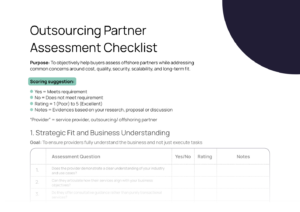
Outsourcing Partner Assessment Checklist preview
Final conclusion
The global outsourcing landscape for 2026 is more about combining specialisation and scale with AI-ready talents, secure operations, and flexible commercial models. The Philippines remains a pivotal part of this landscape, offering businesses with the scale, linguistic advantage, and increasing digital skillsets buyers need. Focused partners like Deployed Philippines can enable growth, digital transformation, and long-term resilience for firms that want to scale efficiently and manage risks effectively.
Ready to build your team and grow your business? Explore Deployed services today.
Sources: Grand View Research, Grand View Research BPO Market, Grand View Research APAC BPO, IT Pro, McKinsey & Company, Aditi Consulting, IT Convergence, IBPAP , PhilStar Business

Why Transport & Logistics Firms Struggle With Operational Admin
Transport and logistics has always been an industry built on precision. Vehicles move o...

Employer of Record vs BPO: Look Beyond the Buzzwords
Employer of Record (EOR) has become one of the loudest phrases in global hiring. It ...

How Can You Manage Quality Expectations in Offshore Teams Delivery
Managing Quality Expectations High-performing offshore teams are built on clear qualit...