



UK SMEs & Enterprise Outsourcing Trends in 2026
10/10/2025
4 Minute read


Outsourcing an Emerging Strategy in the UK Market
As the UK economy enters 2026, outsourcing is emerging as a key strategic tool for both small and medium-sized enterprises (SMEs) and large corporations. Faced with rising costs, tight labour markets, weak confidence, and technological disruption, UK businesses increasingly turn to external partners to reduce operational pressures, accelerate innovation, and access digital talent.
This article outlines the major outsourcing trends in the UK, examines policy and economic pressures, explains why outsourcing is beneficial for SMEs and larger organisations, and offers strategic guidance for 2026 and beyond.
Scale and Growth
The UK stands as one of Europe’s largest outsourcing markets, with strong growth prospects in the coming decade:
Outsourcing Services Market (UK Forecast)
- 2024 revenue: ~US$219.5 billion
- 2030 projected revenue: ~US$387.3 billion
- Expected CAGR (2025–2030): ~10.2%
This growth occurs alongside demand for digital services, IT outsourcing, and managed solutions across both SMEs and enterprise segments.
Additionally, the UK outsourced IT services market alone is forecast to nearly double from USD 24.56 billion in 2024 to USD 52.03 billion by 2033, reflecting demand for tech talent and digital delivery partners.
Economic Pressures and Business Confidence in the UK
Recent economic signals show mixed performance for UK firms:
- Service sector growth remains modest, and business confidence has dipped amid cost pressures, wage growth and rising input prices.
- SMEs report tightening conditions: tax changes, labour cost inflation and cash-flow constraints are cited as top concerns in business surveys.
These dynamics make cost-efficient models like outsourcing a compelling tool for operational flexibility.
Top Outsourcing Trends for UK Businesses in 2026
1. Strategic Outsourcing for Digital Transformation
Unlike traditional transactional outsourcing, modern UK firms prioritise outsourcing that supports:
- Cloud services & IT infrastructure
- Data analytics & AI integrations
- Cybersecurity functions
- Omnichannel customer support
This shift mirrors a global trend where outsourcing is used to accelerate digital initiatives rather than merely reduce costs.
2. SMEs Increasingly Engage External Partners for Core Functions
UK SMEs are scaling through outsourcing functions including:
- Finance & accounting – gaining financial expertise without full-time hires.
- Marketing & digital operations – accessing specialist skills.
- Customer support & back-office – ensuring service continuity.
Outsourcing enables SMEs to focus resources on innovation and growth rather than routine tasks.
3. Outsourcing as a Solution to Skill Shortages
UK firms face chronic digital and tech skill gaps, especially around AI, cloud and cybersecurity. Outsourcing allows organisations to tap global talent pools without long recruitment cycles.
Barclays research shows that many UK SMEs plan to integrate AI and digital tools in the next 12–24 months to enhance productivity and competitiveness, while also facing internal skill shortages
4. Offshore & Nearshore Partnerships on the Rise
UK enterprises and SMEs increasingly adopt multi-shore strategies, combining onshore governance with nearshore/ offshore delivery for scalability and cost efficiency.
Offshore destinations like the Philippines continue to play major roles, not just for customer support but for specialised technical services, digital roles, and knowledge process outsourcing (KPO).
UK Policy Landscape and Outsourcing Implications
The UK’s digital initiatives and access grants have provided opportunities for SMEs and enterprises to resiliently scale.
Public-Sector Procurement and SME Access
The UK Government digital procurement framework G-Cloud has grown significantly, with annual sales reaching £2.91 billion in 2024-25, much of it through SME participation.
This policy framework illustrates how outsourcing can be made more accessible and transparent, helping SMEs compete for public-sector contracts.
Government Support to SMEs
Programs like the Help to Grow initiative have enrolled over 10,000 SMEs in productivity training, incentivizing better operational and digital strategies.
These schemes underscore government recognition of digital adoption, which is often supported by external partners, as central to SME resilience.
This landscape has opened outsourcing support implications for firms wanting to competitively grow and quickly adapt to digital transformation.
Outsourcing Benefits for UK Businesses
1. Cost Efficiency and Flexibility
Outsourcing allows UK companies to convert fixed costs into variable costs, freeing up capital for investment and growth.
2. Access to Expertise and Digital Skills
External partners bring specialised capabilities, especially in IT, cybersecurity, finance, and analytics, that many SMEs cannot justify hiring full-time.
3. Scalability and Operational Resilience
By tapping external teams, firms can scale quickly without lengthy hiring or internal training cycles crucial in competitive markets.
Risks and Mitigations – Actionable 2026 Strategy Checklist
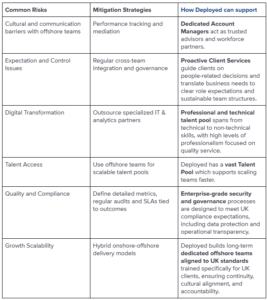
To initially assess compatibility with an offshore partner, you may download Outsourcing Partner Assessment Checklist here.
Next Steps…
In 2026, outsourcing in the UK is at a strategic inflection point, far beyond cost savings. It is a mechanism for digitally accelerated growth, global talent access, and organisational agility. For SMEs and larger enterprises alike, partnering with expert outsourcing providers enables UK firms to stay competitive amid economic pressures, skill shortages, and changing customer expectations.
Looking for a trusted external partner? Let Deployed help you competitively scale your business. Book a discovery call with Deployed today.
——
Sources: Grand View Research, iMarc Group, Reuters, The Times, TechRadar, Financial Times

Why Transport & Logistics Firms Struggle With Operational Admin
Transport and logistics has always been an industry built on precision. Vehicles move o...

Employer of Record vs BPO: Look Beyond the Buzzwords
Employer of Record (EOR) has become one of the loudest phrases in global hiring. It ...

How Can You Manage Quality Expectations in Offshore Teams Delivery
Managing Quality Expectations High-performing offshore teams are built on clear qualit...